In the next couple of decades, we will be able to do things that would have seemed like magic to our grandparents.
This phenomenon is not new, but it will be newly accelerated. People have become dramatically more capable over time; we can already accomplish things now that our predecessors would have believed to be impossible.
We are more capable not because of genetic change, but because we benefit from the infrastructure of society being way smarter and more capable than any one of us; in an important sense, society itself is a form of advanced intelligence. Our grandparents – and the generations that came before them – built and achieved great things. They contributed to the scaffolding of human progress that we all benefit from. AI will give people tools to solve hard problems and help us add new struts to that scaffolding that we couldn’t have figured out on our own. The story of progress will continue, and our children will be able to do things we can’t.
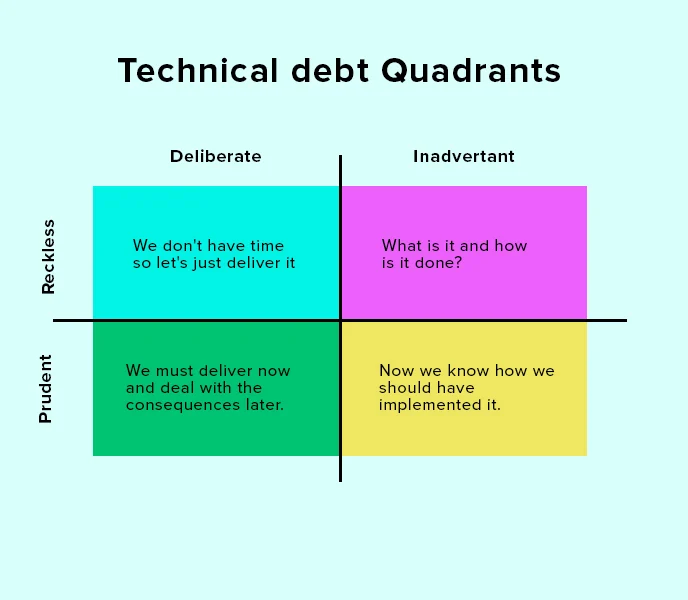
In software development, “technical debt” is a term used to describe the accumulation of shortcuts, suboptimal solutions, and outdated code that occur as developers rush to meet deadlines or prioritize immediate goals over long-term maintainability. While this concept initially seems abstract, its consequences are concrete and can significantly affect the security, usability, and stability of software systems.
The Nature of Technical Debt
Technical debt arises when software engineers choose a less-than-ideal implementation in the interest of saving time or reducing upfront effort. Much like financial debt, these decisions come with an interest rate: over time, the cost of maintaining and updating the system increases, and more effort is required to fix problems that stem from earlier choices. In extreme cases, technical debt can slow development to a crawl, causing future updates or improvements to become far more difficult than they would have been with cleaner, more scalable code.
Impact on Security
One of the most significant threats posed by technical debt is the vulnerability it creates in terms of software security. Outdated code often lacks the latest security patches or is built on legacy systems that are no longer supported. Attackers can exploit these weaknesses, leading to data breaches, ransomware, or other forms of cybercrime. Furthermore, as systems grow more complex and the debt compounds, identifying and fixing vulnerabilities becomes increasingly challenging. Failing to address technical debt leaves an organization exposed to security risks that may only become apparent after a costly incident.
Impact on Usability
Technical debt also affects the user experience. Systems burdened by outdated code often become clunky and slow, leading to poor usability. Engineers may find themselves continuously patching minor issues rather than implementing larger, user-centric improvements. Over time, this results in a product that feels antiquated, is difficult to use, or lacks modern functionality. In a competitive market, poor usability can alienate users, causing a loss of confidence and driving them to alternative products or services.
Impact on Stability
Stability is another critical area impacted by technical debt. As developers add features or make updates to systems weighed down by previous quick fixes, they run the risk of introducing bugs or causing system crashes. The tangled, fragile nature of code laden with technical debt makes troubleshooting difficult and increases the likelihood of cascading failures. Over time, instability in the software can erode both the trust of users and the efficiency of the development team, as more resources are dedicated to resolving recurring issues rather than innovating or expanding the system’s capabilities.
The Long-Term Costs of Ignoring Technical Debt
While technical debt can provide short-term gains by speeding up initial development, the long-term costs are much higher. Unaddressed technical debt can lead to project delays, escalating maintenance costs, and an ever-widening gap between current code and modern best practices. The more technical debt accumulates, the harder and more expensive it becomes to address. For many companies, failing to pay down this debt eventually results in a critical juncture: either invest heavily in refactoring the codebase or face an expensive overhaul to rebuild from the ground up.
Conclusion
Technical debt is an unavoidable aspect of software development, but understanding its perils is essential for minimizing its impact on security, usability, and stability. By actively managing technical debt—whether through regular refactoring, code audits, or simply prioritizing long-term quality over short-term expedience—organizations can avoid the most dangerous consequences and ensure their software remains robust and reliable in an ever-changing technological landscape.
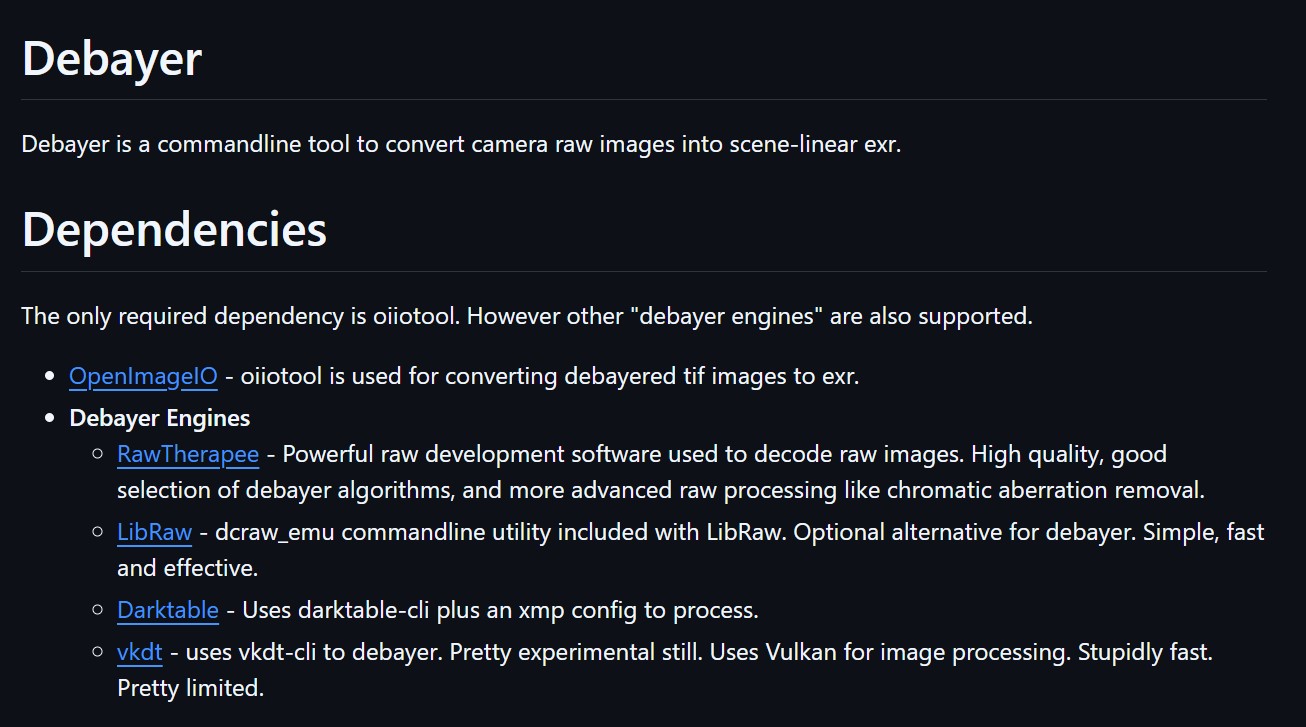
The only required dependency is oiiotool. However other “debayer engines” are also supported.
OpenImageIO – oiiotool is used for converting debayered tif images to exr.
Debayer Engines
RawTherapee – Powerful raw development software used to decode raw images. High quality, good selection of debayer algorithms, and more advanced raw processing like chromatic aberration removal.
LibRaw – dcraw_emu commandline utility included with LibRaw. Optional alternative for debayer. Simple, fast and effective.
Darktable – Uses darktable-cli plus an xmp config to process.
vkdt – uses vkdt-cli to debayer. Pretty experimental still. Uses Vulkan for image processing. Stupidly fast. Pretty limited.
“As human beings, it’s very easy for us to have common sense, and apply it at the right time and adapt it to new problems,” says Ilievski, who describes his branch of computer science as “common sense AI”. But right now, AI has a “general lack of grounding in the world”, which makes that kind of basic, flexible reasoning a struggle.
AI excels at pattern recognition, “but it tends to be worse than humans at questions that require more abstract thinking”, says Xaq Pitkow, an associate professor at Carnegie Mellon University in the US, who studies the intersection of AI and neuroscience. In many cases, though, it depends on the problem.
The goal is to reduce costs by replacing traditional storyboard artists and VFX crews with AI-generated “cinematic video.” Lionsgate hopes to use this technology for both pre- and post-production processes. While the company promotes the cost-saving potential, the creative community has raised concerns, as Runway is currently facing a lawsuit over copyright infringement.
At the age of 94, this is what the great Clint Eastwood looks like.
Standing, lucid, brilliant, directing his latest film. Eastwood himself says it: “I don’t let the old man in. I keep myself busy. You have to stay active, alive, happy, strong, capable. I don’t let in the old critic, hostile, envious, gossiping, full of rage and complaints, of lack of courage, which denies to itself that old age can be creative, decisive, full of light and projection. Getting older is not for sissies.”
Load holograms, animate cameras, capture frames, and feed them to your favorite AI models. Developed by Lovis Odin for Kartel.ai You can obtain the MPD URL directly from the official 8i Web Player.
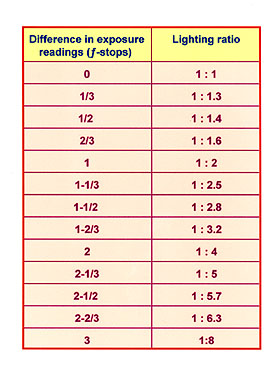
To measure the contrast ratio you will need a light meter. The process starts with you measuring the main source of light, or the key light.
Get a reading from the brightest area on the face of your subject. Then, measure the area lit by the secondary light, or fill light. To make sense of what you have just measured you have to understand that the information you have just gathered is in F-stops, a measure of light. With each additional F-stop, for example going one stop from f/1.4 to f/2.0, you create a doubling of light. The reverse is also true; moving one stop from f/8.0 to f/5.6 results in a halving of the light.
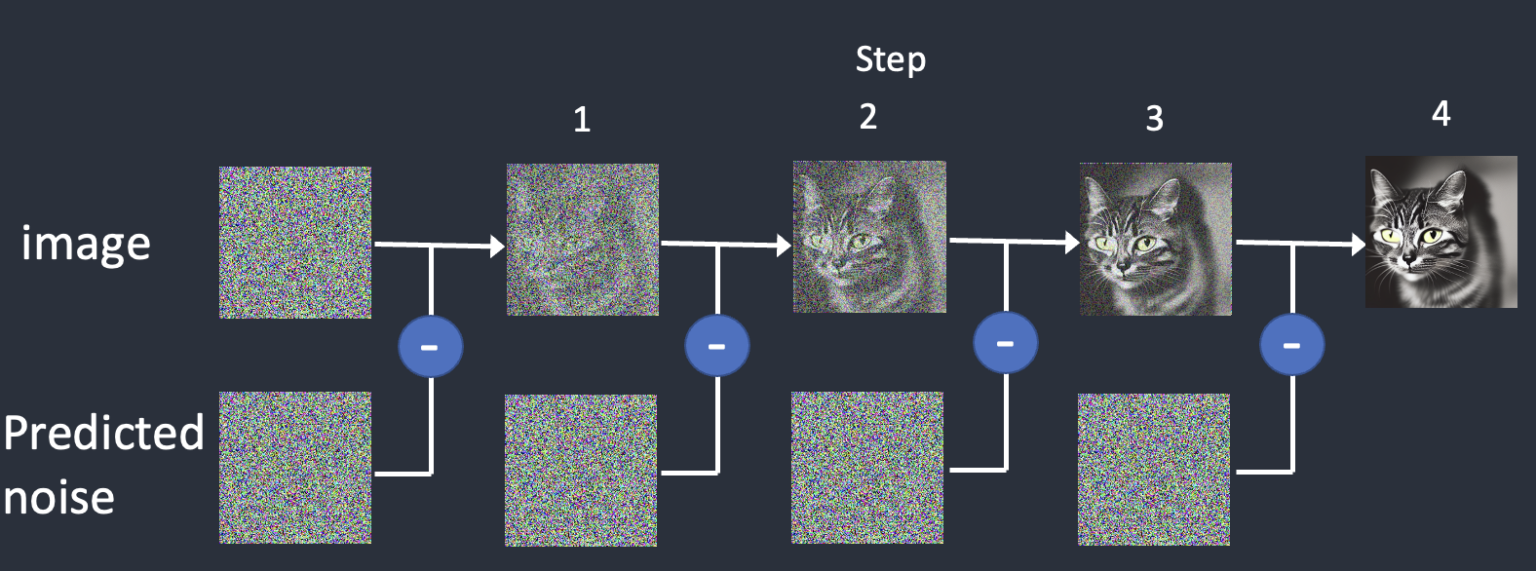
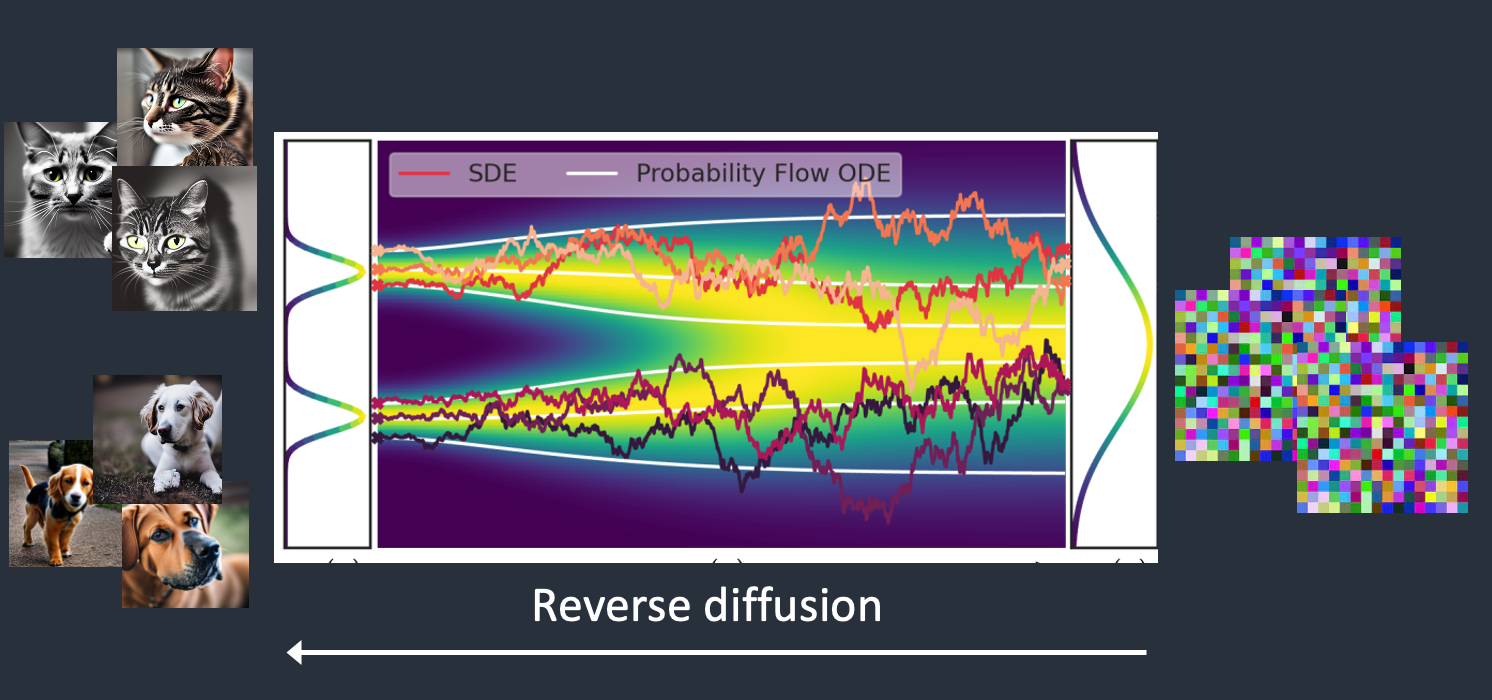
Stable Diffusion is a latent diffusion model that generates AI images from text. Instead of operating in the high-dimensional image space, it first compresses the image into the latent space.
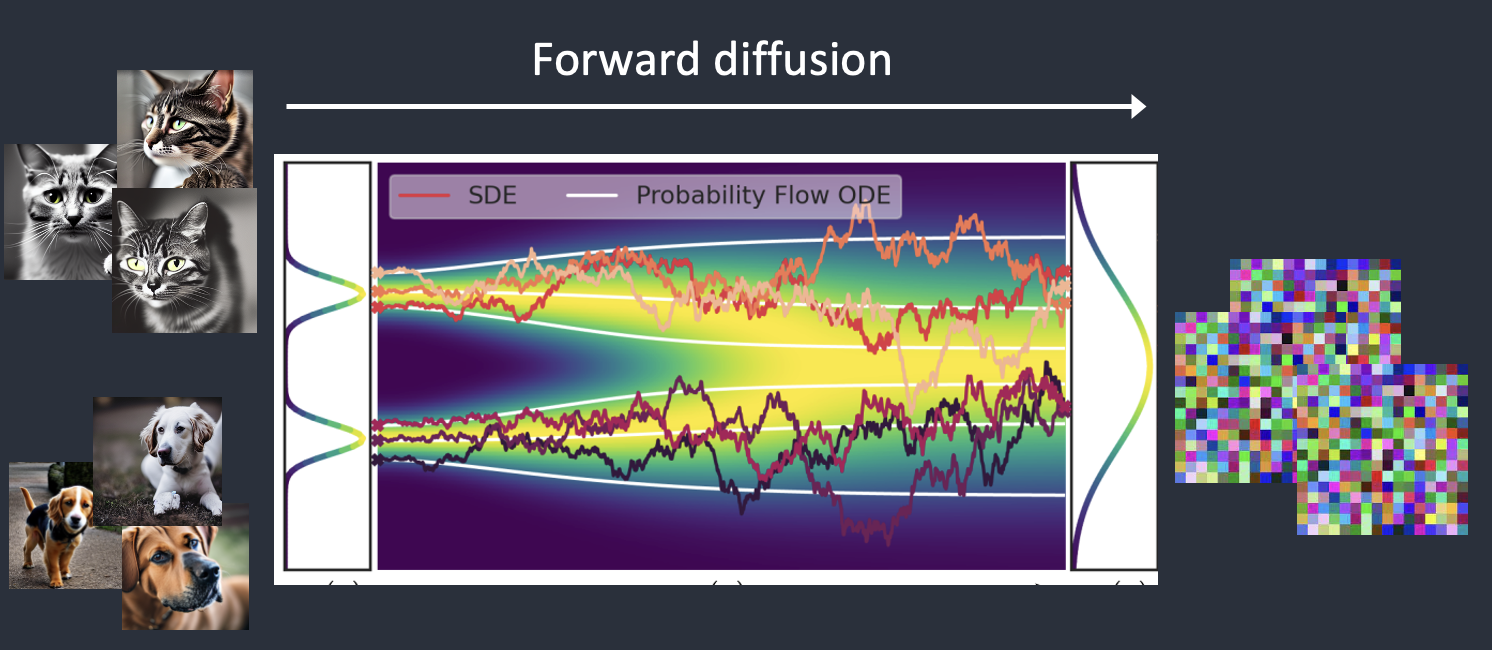
Stable Diffusion belongs to a class of deep learning models called diffusion models. They are generative models, meaning they are designed to generate new data similar to what they have seen in training. In the case of Stable Diffusion, the data are images.
Why is it called the diffusion model? Because its math looks very much like diffusion in physics. Let’s go through the idea.
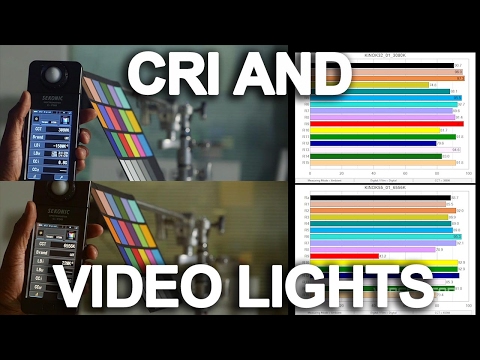
“The Color Rendering Index is a measurement of how faithfully a light source reveals the colors of whatever it illuminates, it describes the ability of a light source to reveal the color of an object, as compared to the color a natural light source would provide. The highest possible CRI is 100. A CRI of 100 generally refers to a perfect black body, like a tungsten light source or the sun. ”